

Rising revenue with falling profit almost always means a business skipped the “optimize” step of the growth cycle (start, build, optimize, expand) and is scaling on top of undocumented operations. Fix it by pausing new growth spend, assigning ownership/metrics/cadence to each core function, and recalibrating pricing to true fully-loaded cost before pushing revenue further.
Imagine this scenario. You just closed your biggest revenue year ever. The team grew. The customer base grew. The reputation grew. And when you sat down with your accountant in January, the net income line was lower than it was the year before.
If that sounds familiar, you are not alone. I see this pattern every single week with owners between $5M and $25M in revenue. They’re scaling, the market is responding, but the profitability is going in the wrong direction. They assume they need a sales push or a price increase, but they’re wrong. That’s because the problem is structural.
The pattern every founder eventually recognizes
It usually shows up the same way. Top line is up 20-40% year over year. The team has grown by half. You’re working more hours than you were two years ago. And the bank balance is somehow tighter, not looser.
You start asking the obvious questions. Are we underpriced? Are we underbilling? Is the team taking advantage of us? Nine times out of ten, the problem is none of the above. The real problem is that you’re scaling on top of operational work you never finished.
The real business cycle most owners skip
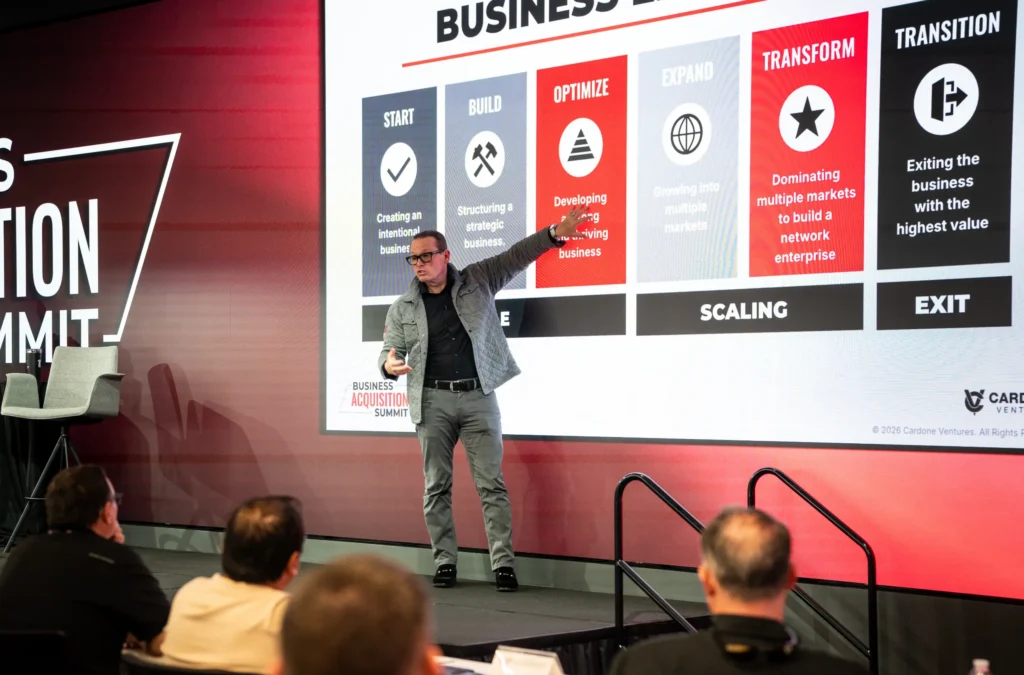
There’s a cycle every business has to go through, and most owners only do three of the four steps. They start. They build. And then, instead of optimizing first, they expand. The fourth step (optimize) is where real profitability is engineered, and skipping it doesn’t just delay growth. It actively destroys it.
Here’s the right cycle: start, build, optimize, and only then do you ‘accidentally’ expand. I use the word ‘accidentally’ because that’s the whole game. You shouldn’t have to force expansion. When you’ve optimized properly, opportunities pull you into expansion. Clients ask for adjacent work, partners offer new markets, and the team starts proposing things you hadn’t even thought of. That’s a sign the foundation is ready.
When you’re forcing expansion to keep up with revenue targets, you’re scaling chaos. That chaos is what’s eating your margin.
What skipping “optimize” actually looks like
I’ll give you the symptoms. You’re reporting revenue, but no one on the team can tell you the gross margin on each service line. Your books are reconciled six weeks late. Your sales team doesn’t know what your fully loaded cost per job is. Your marketing spend isn’t tied to a customer acquisition cost. Your operations team is heroic but undocumented, which means every problem ends up at the founder’s desk.
Each of those gaps is invisible at $3M and existential at $10M. Every dollar of new revenue you pour into an unoptimized business loses you a few cents of margin. Multiply that across a few million in growth, and you’re a record-revenue, lower-profit business.
A real example: from -3% to 23% in nine months
I worked with a roofing client who came into Elite Edge running about $10 million in revenue. Looking at his books, his net was negative 3%. He was spending money he didn’t have, growing for the sake of growth, and getting punished for it. He hadn’t implemented anything sophisticated yet. All he did, in the first nine months, was clean up the mess.
Books got accurate. P&L got reviewed monthly. Cash flow got monitored weekly. The bottom 69% of underperformers got curated. Pricing got recalibrated to actual fully loaded cost. Marketing got paused, because there was no point spending another dollar on top of a broken system.
Nine months later, his run rate was $13.5 million in revenue at 23% net income; fewer dollars on top, but dramatically more dollars in the bank. That’s what optimizing looks like when you finally do it. The revenue follows the profitability, not the other way around.
The “accidental expansion” test
Want to know if you’re ready to scale? Ask yourself this: are clients pulling you into new markets, services, or sizes? Or are you pushing into them? If clients are pulling you in, your foundation is solid, and the expansion is real. If you’re pushing, you’re probably going to lose margin doing it.
When you don’t pass the accidental-expansion test, the answer isn’t to slow down. The answer is to redirect the energy from external growth back into internal optimization until the foundation is ready.
What to do this week
Here’s your homework. Pull two reports. The first is a year-over-year comparison of revenue and net income. The second is a list of every operational function in your business (finance, sales, marketing, operations, people) with one question next to each: Is there an owner, a metric, and a weekly cadence in place? If the answer is “no” or “kind of” for any of them, that’s where your margin is leaking.
Stop optimizing for revenue. Optimize for the function that’s least defined. Profitability follows.
Get the diagnostic
Cardone Ventures runs the Elite Edge to help business owners expose the gaps. Three days, a full operational diagnostic, and the same blueprint that helps our clients trade unsustainable growth for real, measurable, lasting profitability. Owners walk away with the plan to optimize before they expand. Reserve your seat at the next Elite Edge.
Profitability Paradox FAQs
Because the business expanded before optimizing — every new dollar of revenue flows through an inefficient, undocumented operation, so growth compounds the margin leak instead of fixing it.
Ask whether clients are pulling you into new markets/services (a sign your foundation is solid) or whether you’re pushing into them to hit a target (a sign you’ll lose margin doing it).
Start, build, optimize, then expand — expansion should follow optimization, not substitute for it.
Pull a year-over-year revenue vs. net income comparison, and check every core function (finance, sales, marketing, operations, people) for a clear owner, metric, and weekly cadence.